Home
Drupal life hacks

Main navigation

  • Drupal
  • React
  • WP
  • Contact
  • About
User account menu
  • Log in

Breadcrumb

  1. Home

web development

By admin, 14 September, 2026
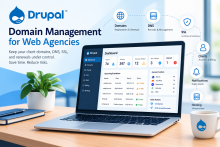
Drupal domain management dashboard for web agencies

How Do Drupal Developers Manage Their Clients’ Domains?

Drupal domain management can become surprisingly complicated when a developer or small web agency manages dozens or hundreds of client websites. Domains, DNS records, SSL certificates, renewals, expiration dates, payments, and different registrars all have to be tracked and maintained.

I have a practical question for Drupal developers and small web agencies.

If you build and maintain websites for clients, sooner or later you face a task that is not directly related to Drupal development: managing domains, DNS, SSL certificates, and renewals.

Tags

  • Drupal
  • Domain Management
  • web development
  • Web Agencies
  • Domain Registration
  • DNS
  • SSL
  • SaaS
  • Drupal Development
  • Freelancing
By admin, 4 January, 2026

Implementing a Real-World Feature Across Drupal, Symfony, and Laravel

Implementing a Real-World Feature Across Drupal, Symfony, and Laravel

Feature: E-Commerce “Discount Code Validator”

Requirement:

  • When a user applies a discount code during checkout:
    • Validate the code
    • Check expiration and usage limits
    • Calculate discount
    • Return an updated order total
  • Must be extensible for future promotion types

This feature is small but touches services, events, plugins, and DI—perfect for comparing modular approaches.

Tags

  • Drupal
  • Symfony
  • Laravel
  • PHP
  • modularity
  • Dependency Injection
  • DI
  • plugin API
  • service provider
  • Services
  • bundles
  • CMS
  • web development
  • PHP frameworks
  • software architecture
  • extensibility
  • Drupal module
  • Symfony Components
  • Laravel packages
  • event system
  • Service Container
  • Autowiring
  • software design
  • code reusability
  • feature implementation
By admin, 30 December, 2025
Universal “Soldier” in PHP. Templating: Twig vs Blade

Universal “Soldier” in PHP. Templating: Twig vs Blade

Universal “Soldier” in PHP

Templating: Twig vs Blade

After controllers, DI, and Request handling, the next key layer is view rendering.
In PHP frameworks, this usually means templating engines:

  • Symfony/Drupal: Twig
  • Laravel: Blade

Even though the syntax differs, the concept is the same: the controller prepares data, passes it to a template, and the template renders HTML.

Tags

  • PHP
  • Symfony
  • Laravel
  • Drupal
  • Twig
  • Blade
  • templating
  • Controller
  • universal soldier
  • Dependency Injection
  • Request Handling
  • web development
  • PHP frameworks
  • blog tutorial
  • PHP templates
  • frontend rendering
  • MVC
  • render HTML
By admin, 28 December, 2025
Universal “Soldier” in PHP.  Request & Input: How Data Enters Controllers (Symfony, Laravel, Drupal)

Universal “Soldier” in PHP. Request & Input: How Data Enters Controllers (Symfony, Laravel, Drupal)

Universal “Soldier” in PHP

Request & Input: How Data Enters Controllers (Symfony, Laravel, Drupal)

After controllers and Dependency Injection, we reach the next universal concept in every PHP framework:

👉 How does user input get into your code?

Query params, POST data, headers, cookies, files — everything starts with HTTP Request.

Good news again:

All modern PHP frameworks handle input the same way.

Tags

  • PHP
  • Symfony
  • Laravel
  • Drupal
  • Dependency Injection
  • controllers
  • Request Handling
  • web development
  • Backend Development
  • MVC
  • software architecture
  • Service Container
By admin, 24 December, 2025
Universal PHP controller architecture across Symfony, Laravel, and Drupal frameworks

The Universal “Soldier” in PHP. How to Tame Any Framework. Step One — The Controller

The Universal “Soldier” in PHP

How to Tame Any Framework. Step One — The Controller

The PHP ecosystem is fragmented: Symfony, Laravel, Drupal, Yii, Slim…
At first glance, each framework feels like a separate universe with its own rules, magic, and “correct” way of doing things.

But there is good news:

90% of modern PHP frameworks speak the same language.
That language is HTTP and Symfony Components.

Tags

  • PHP
  • Symfony
  • Laravel
  • Drupal
  • PHP frameworks
  • controllers
  • web development
  • Backend Development
  • software architecture
  • MVC
  • HTTP
  • Symfony Components
  • framework agnostic PHP
  • PHP tutorial
  • clean code
web development
Powered by Drupal